Price: $265
Why Buy?
The Helm Finn in the Sienna make up is a versatile and affordable option in the casual chelsea boot range.
Why Avoid?
The Helm Finn in the Sienna make up might patina more than some like, and doesn’t have great arch support.
Specs
| Model | Finn |
| Height | 5.75″ |
| Size | 12 D |
| Weight | 776 g / 1 lb 11.4 oz |
| Materails | Waxed Suede / Leather / Rubber |
| Construction | Blake Rapid |
| Country of Origin | Brazil |
History

Last year 100wears took a look at the then-brand-new Helm Finn in the Sienna make up. The take away was that this was a boot that fit the Helm aesthetic better than anything else they offered, and at a great price.
However, it’s easy to make something look good out of the box. Well, easy enough. If you’re going to be investing nearly 300 dollars in something, you want to make sure it’ll also stand the test of time.
I’ve worn this pair of Helm Finns over 100 times, and for more than 100 miles. I try to wear shoes for the environment they were designed for – in this case, they were mostly worn at places like outdoor breweries, taking the dog out, etc. They didn’t see hard hiking, or beatings on concrete.
Should you consider a pair? Let’s dive in and find out
Looks
Upper

Your view of how the upper held up will depend on what you’re hoping for in your pair of Helm Finns. Waxed suede, almost by definition, is going to get patina’d. Neither wax nor suede are known for being able to take big hits. This boot is no exception to that rule.
With wear, these have picked up clear wear patterns along the toe and heel. Areas that had lots of wax were scrapped and became textured. Areas with texture became flattened and higher gloss. That is a feature, not a bug, but if you don’t like the idea of this you might want to consider one of the leather pairs.

The only part that I didn’t find appealing as it patina’d was right along the ball of the foot. For whatever reason, the creasing and folding created a mottled appearance. This wouldn’t be a huge deal, but right next to the heavily waxed toe it looked like two contrasting designs. If I were to change one thing, it would be to either add less wax to the toe, or more to the midfoot.
Another key feature that developed with wear was the overall shape. The suede is a very pliable material, so the shaft of the boot will take on a worn-in look. Again, this is something many will look for in the boot, but if you don’t like it the leather versions should stay more structured.
When it comes to the details, all of them have held up extremely well. Both the pull tabs are still securely locked into place. The elastic is tight. Even the saying under the heel has held up well.
Mid- and Outsole

The one big worry I had about the Helm Finn was the durability of the outsole. It was made of a very soft rubber, so I thought the trade off would be durability. To my surprise, they have held up surprisingly well.
Everyone’s gait, weight, etc. will change your own personal wear patterns, but for me the area under the ball of the foot hardly looks worn at all. The front and back do show a bit more wear, but durability shouldn’t be a big concern for these.

The boot has started to develop a bit of a springed toe with wear. Or, to put it another way, the outsole has started to curve up near the toe. This is hard to avoid with thicker midsoles, but it isn’t something that has happened on my other Helm boots so it’s worth mentioning.
Summary

Overall, the Helm Finn has held up surprisingly well. It’s developed over time – as you should expect with this material – but has shown to be more durable than you might expect.
Personally, I’ve found that these go best on days where you want to look put together but not fussy. Afternoon hanging out with friends, popping over to the neighbors, etc. There is a casual/cool vibe to the Helm Finn that elevates them above service boots/sneakers, but doesn’t feel like you “dressed up.”
Being thinner by nature, I find that they work best with similarly slim fabrics. You might not want to wear these with wide cuts or heavy denim, but cotton chinos or summer weight jeans work great.
Fit & Comfort
Fit

The 416 last debuted with the Helm Finn, so nobody really knew how it would develop over time during the initial review. They did stretch out after a few steps, but held steady after the first couple of miles.
These boots are pretty narrow overall, which is common in the Chelsea boot world. Helm does offer these in wider sizing, but be careful not to go too wide as you might just step right out of the boot.
Helm recommends going a half size down in these, but I would caution against that unless you have very narrow feet. The reason that the boot stopped stretching is a fairly tough heel counter and toe stiffener. In a battle between your toes and that plastic, the plastic will win.
I wear these in a size 12, which is where I buy most of my dressier goodyear welted shoes such as my Allen Edmonds. For comparison, I wear an 11.5 E in most work boots, and a 13 in sneakers. For a full list of sizing for every shoe reviewed on this site, click here.
Comfort

After wearing these boots for over 100 miles, I have to say that my initial impressions of the Helm Finn were spot on. The Blake-Rapid construction prevents a built up arch, but the combination of the foam insole and thick rubber outsole offer plenty of squish.
These are probably not the boots I’d pick if I was doing something like moving furniture, but I wouldn’t hesitate wearing them for a full day.
Materials & Construction
Materials
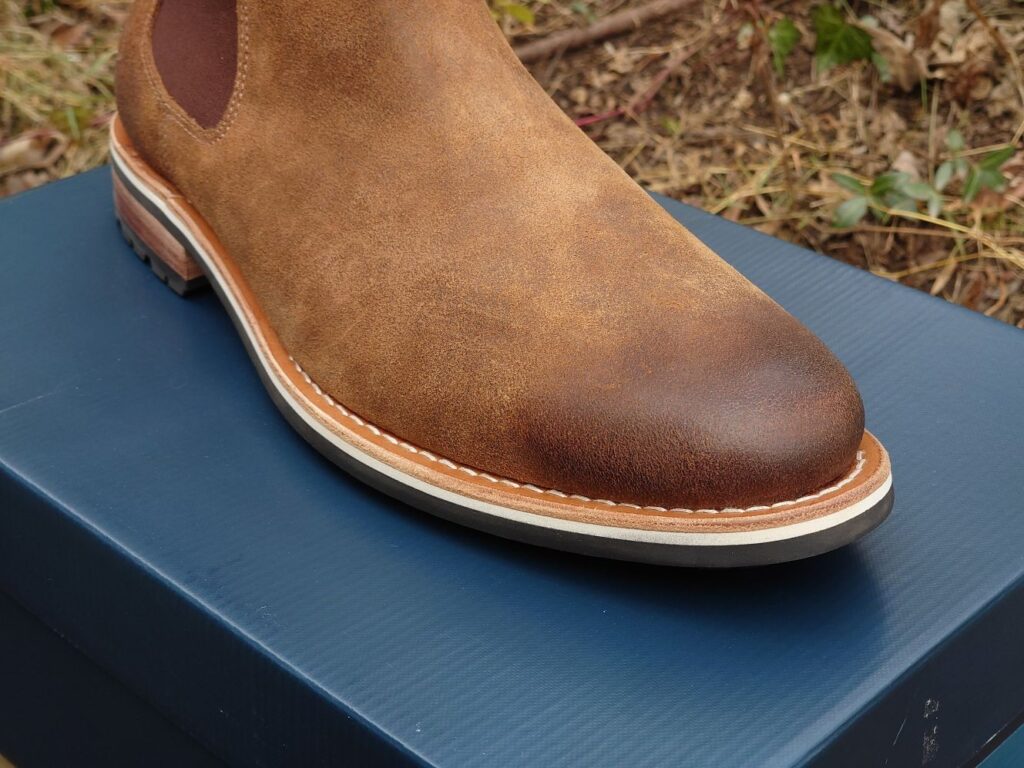
Starting with the primary material on the upper, this particular make up of the Helm Finn uses waxed suede from the Rusan tannery. The suede feels great, though admittedly you feel the wax more than the suede.
If you’re not familiar with waxed suede, it’s exactly what the name describes. The idea is to take suede – a naturally durable material to pretty much everything but water – and to combine it with wax – a naturally water resistant material that is otherwise entirely mailable. It’s very similar to a waxed cotton jacket.
Inside, the boot is lined with a glove leather, and the upper is finished off with elastic bands and a polyester pull tab. In between the lining and the outer leather are clastic heel and toe caps.
Underfoot, Helm uses the foam insole they use on all of their boots. I’m not typically a fan of man-made materials for the insole, but this feels good and is replaced as part of their resole package. Underneath that you’ll find a layer of leather, then a layer of rubber, then the rubber outsole.
The rubber outsole is Helm’s own blend, but feels incredibly soft. That might raise durability concerns, but it’s so thick that you’ll get plenty of life out of it. The heel stack is topped off with more lugged rubber.
Construction

The Helm Finn is made using their Blake Rapid construction style at their factory in Brazil. It does look a bit different than their previous models – from underneath it looks like a more traditional Blake construction – but I was able to confirm with the brand that this is still made with Blake Rapid.
Blake Rapid is a really interesting way of making footwear. Simple Blake construction has the benefit of being easy to make and very flexible, but it has one major drawback – the exterior stitching runs straight into the inside. It’s just about the least water-resistant way to make a shoe. There is a direct path from the ground to your sock. Makers will use waxes to try and hold back water as much as possible, but ultimately the water resistance of that style is quite poor.
Blake Rapid changes this by taking what would be the outsole of a Blake shoe, and stitching another layer to it with a Rapid stitch. Similar to how you connect an outsole to the welt on a goodyear welted shoe.
The benefits of Blake Rapid is that this offers the slimmer design of Blake, without the drawbacks of weather resistance. It’s also a bit easier to resole – though a lot of cobblers may not be familiar with it. As for drawbacks, due to the location of the internal stitching, it’s hard to get arch support without using a drop in insole.
Ease of Care

Taking care of the Helm Finn has been incredibly simple.
I did end up waxing these a bit more than I expected – I found that the mottled look where the boot bends wasn’t my preference – but didn’t need to. It was an entirely stylistic choice and as far as weather protection goes the boot was in great shape. You can find Helm’s suggested wax here.
I should say, Helm suggests regularly using waterproofing spray. However, in my experience, you likely won’t need this for at least a year of wear. The wax holds up well, and if you plan on ever rewaxing them the waterproofing spray would be redundant.

As for trees, I did keep a pair of standard shoe trees in these, but for the first time I would actually recommend going with a specific type. Due to the thicker outsole, these boots did start to get a bit of spring to the toe. Some might not mind this, in fact some people prefer this, but if you don’t a more substantial shoe tree will help prevent it.
After some wear, I switched over to a Woodlore Epic Shoe Tree. This design seemed to stop the change in shape better than the split toe model that I was using.
This pair isn’t anywhere near needing a resole, but when they do it is important to highlight Helm’s resole program with NuShoe. Coming in at $135, it’ll likely be more affordable than a local cobbler and if something goes wrong you can bring it up directly with Helm.
Is the Helm Finn Worth It?

Still coming in at the same price as the initial review – $265 – is the Helm Finn Chelsea boot worth it? I’d say so.
Is the Helm Finn flawless? Of course not. I would love to have seen more even waxing. However, being priced at 1/3rd the cost of the more famous Chelsea boots available, Helm’s focus is offering one of the best value propositions out there. In that they have knocked it out of the park.
Even more impressive, after wearing these I’ve found that the biggest concern I had (the durability of the outsole) was completely overblown. You’ll easily be able to get 3 or 400 miles from these as long as you’re not exclusively walking on concrete sidewalks.
I stand by my initial impression – if you’re looking for a casual Chelsea boot under $300, it’s hard to go wrong with the Helm Finn.